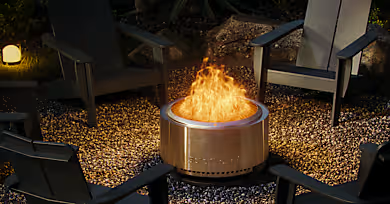
A smokeless fire pit works by pulling air in through vents at the base, heating that air as it travels up through a gap between the two walls, then releasing it through a second set of vents near the rim. That preheated air re-ignites the smoke and unburned gases rising off the fire — a process called secondary combustion — burning them up before they can escape as visible smoke.
That's the short version. Below, we'll break down exactly what's happening at each stage, why it works, and where the "smokeless" label does and does not hold up in practice.
The Two Burns: Primary and Secondary Combustion
Every wood fire, smokeless or not, starts with what's called the primary burn. This is ordinary combustion: wood, oxygen, and heat combine to produce flame, carbon dioxide, water vapor — and, critically, a mix of unburned carbon particles and volatile gases. That leftover mix is what you see and smell as smoke.
A traditional open fire ring has no way to deal with that byproduct, so it just drifts off into the air (and into your eyes, hair, and clothes).
A smokeless fire pit adds a secondary burn. Instead of letting that smoke escape, the pit's double-wall design captures a stream of superheated air and injects it directly into the rising smoke, at exactly the point where it's hot enough to ignite. The unburned particles and gases combust a second time, converting most of what would have been smoke into more heat, more flame, and mostly harmless water vapor and CO2.
Anatomy of a Double-Wall Fire Pit
The entire system depends on a fire pit having two walls with a sealed gap between them, plus two sets of vent holes:
- Outer wall, bottom vents — Small holes near the base of the outer wall let cool air enter. Some of this air feeds the primary flame directly; the rest is pulled into the gap between the walls.
- The wall gap — As air travels up through this narrow channel, it's heated by the fire burning on the other side of the inner wall. By the time it reaches the top, it's dramatically hotter than the air that went in.
- Inner wall, top vents — A ring of holes near the rim of the inner wall releases that superheated air back into the fire chamber, right above the flame, where the rising smoke and gases are hot enough to reignite on contact.
- Base plate and ash pan — Sits beneath the fire, catching ash so it doesn't clog the bottom vents and choke off the airflow the whole system depends on.
Solo Stove's version of this design is what we call Signature 360° Airflow — the "360°" refers to the vents running around the full circumference of the pit, so air (and the secondary burn it creates) is even on every side, not just wherever a gap happens to be.
Step by Step: What Happens When You Light It
- You light the wood. The primary burn starts, producing heat, flame, and smoke.
- Cool air is drawn in through the bottom vents in the outer wall, feeding the base of the fire.
- A separate stream of air enters the gap between the outer and inner walls and begins heating up as it rises.
- That air exits through the top vents near the rim, now significantly hotter than when it went in.
- The superheated air meets the rising smoke just above the flame, igniting the unburned particles and gases in a secondary burn.
- The result: a taller, more consistent flame, less visible smoke, and noticeably less ash left behind afterward.
Why This Design Actually Reduces Smoke
Smoke is mostly unburned fuel — tiny carbon particles and volatile compounds that escaped combustion because they didn't get enough oxygen or heat before they rose out of the fire. A double-wall pit solves both problems at once: it delivers a second, hotter dose of oxygen exactly where the smoke is concentrated, and it does so while that smoke is still hot enough to combust rather than cool enough to just drift away. That's the whole trick — there's no filter, fan, or battery involved, just airflow shaped by the geometry of the pit itself.
Smokeless vs. Traditional Fire Pit: What's Different
Combustion
- Traditional open fire ring: Primary burn only
- Smokeless (double-wall) fire pit: Primary burn + secondary burn
Smoke
- Traditional open fire ring: Escapes as unburned particles rise
- Smokeless (double-wall) fire pit: Largely re-ignited before it escapes
Ash
- Traditional open fire ring: Accumulates, often needs frequent clearing
- Smokeless (double-wall) fire pit: Reduced, since more fuel is fully combusted
Flame
- Traditional open fire ring: Wider, lower, less consistent
- Smokeless (double-wall) fire pit: Taller, more consistent, more contained
Setup
- Traditional open fire ring: Simple ring or bowl
- Smokeless (double-wall) fire pit: Double-wall construction with two vent systems
Does It Really Work? Setting Realistic Expectations
Two honest caveats worth knowing before you buy:
- Startup smoke is normal. The secondary burn needs heat to work, so expect a brief puff of smoke while the fire establishes itself — the smoke reduction kicks in once the pit is fully up to temperature.
- Wood quality still matters. Wet, green, or unseasoned wood produces more smoke than any airflow system can fully burn off. Dry, seasoned hardwood will always perform better in a smokeless pit than damp firewood will.
Within those limits, the double-wall design does what it claims: independent reviewers and everyday users consistently report dramatically less smoke in their eyes, hair, and clothes compared to an open fire ring of the same size.
Frequently Asked Questions
What is 360° Airflow? It's Solo Stove's name for its double-wall, secondary-combustion system — vents running around the full circumference of the pit pull in and preheat air, then release it back into the fire to burn off smoke, evenly on all sides.
Is secondary combustion the same in every fire pit model? The underlying principle — double walls, bottom vents, top vents — is consistent across wood-burning models, though larger pits move more air and produce a larger secondary burn than smaller ones.
Do smokeless fire pits need special wood? No special wood is required, but dry, seasoned hardwood will always produce less smoke and burn more efficiently than wet or green wood, regardless of the pit design.
Can wind or rain affect how well it works? Strong wind can disrupt the airflow pattern the secondary burn depends on, sometimes pushing smoke to one side temporarily. Light rain generally doesn't affect performance once the fire is established, though it will make lighting the initial primary burn harder.
Does a smokeless fire pit produce less heat than a regular one? It concentrates heat efficiently at the source rather than radiating as widely as a large open fire ring, which is a trade-off worth knowing — see our complete buying guide for how that plays out across different sizes.